Over the years, I’ve had many clients reach out to me with a very specific puppy in mind. Often, they’ve already decided on the breed before even speaking to me.
It’s interesting that sometimes, after only 15 minutes of talk, I can gently steer them in a different path since the breed they originally desired just isn’t suitable for their family or way of life.
Choosing a dog should never be based on what’s popular or what looks adorable on Instagram. Compatibility should be the main focus.
Therefore, how can you determine whether the breed you adore is actually the best fit for you?
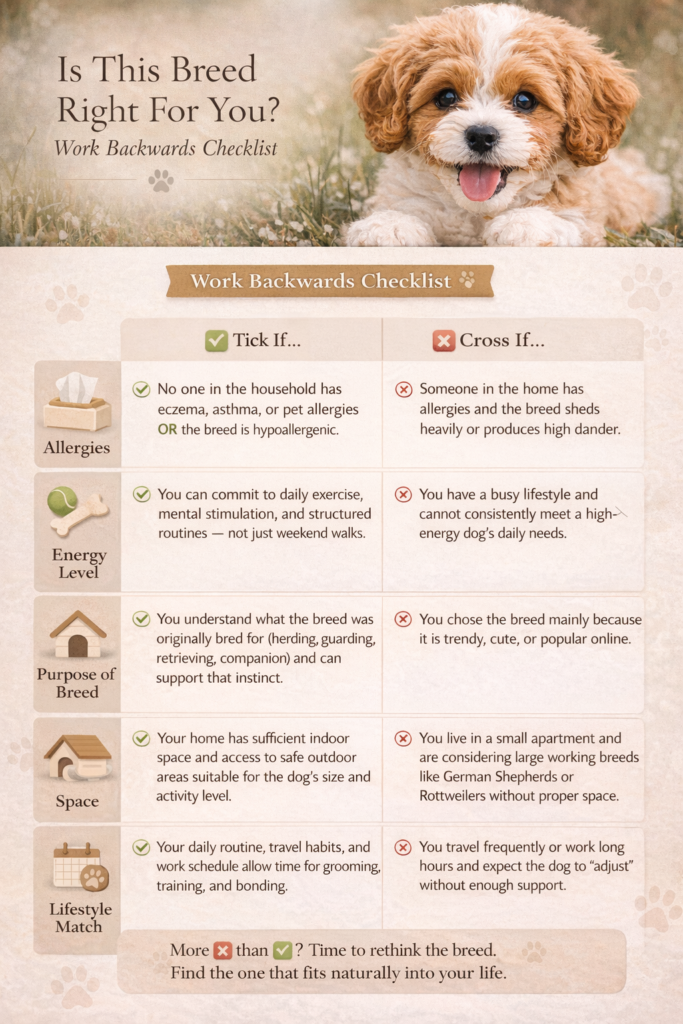
Working backwards is what I usually advise my clients to do.
You should begin with your life rather than the breed.
Allergies

Families contacting me because someone in the home has eczema, asthma, or other allergy-related problems has significantly increased in the past few years.
This should be a key consideration right away if the breed you are thinking about is not hypoallergenic. Bringing home a dog that produces a lot of dander or sheds a lot might exacerbate preexisting diseases and cause your family to experience everyday discomfort.
Long-term health and harmony in the home should always come first, even though it may be disheartening to give up on a breed you love. A puppy should improve, not lower, the quality of life for your family.
Energy

Every breed was originally developed for a purpose. Some were bred to herd, some to guard, some to retrieve, and some purely for companionship.
Energy levels vary dramatically.
Take corgis, for example. They are small, adorable, and very popular. But they are herding dogs. That means they are intelligent, active, and require consistent physical and mental stimulation. Without enough exercise and structure, that pent-up energy can easily turn into excessive barking, destructive behaviour, or hyperactivity.
Ask yourself honestly before selecting a breed. Can I match this dog’s energy level every day, not only on the weekends?
A dog that fits in nicely is a delight. An inappropriate one causes stress for the pet and the family.
Space
Another element that is frequently overlooked is space.
In general, I don’t suggest German Shepherds or Rottweilers for apartment life. These working breeds need more than just leash time, despite the claims of some owners that frequent walks will make up for it. They require areas that accommodate their size and mental requirements, as well as freedom of movement and exploration.
When confined to a small area, large, powerful breeds may grow irritated, nervous, or understimulated.
Examine your living area seriously when thinking about getting a puppy. Do you have enough indoor space?
Is there a secure outdoor area close by?
Will the dog feel comfortable and unrestricted?
The Bigger Picture
Grooming requirements, temperament around children, noise sensitivity, travel lifestyle, financial commitment, and long-term time investment are just a few of the numerous variables to take into account in addition to allergies, energy, and space.
Getting a puppy is a long-term choice. The devotion lasts for ten to fifteen years.The ideal breed should fit your daily schedule, the dynamics of your home, and your capacity as an owner.
At Woof Loof, my role is not simply to source puppies. It is to ensure that families make informed, responsible decisions. Sometimes that means recommending a different breed than the one you initially fell in love with. And more often than not, months later, clients tell me it was the best advice they received.
When you choose based on compatibility rather than impulse, you set yourself and your puppy up for a lifetime of success.
If you’re unsure about which breed is right for you, start with your lifestyle. The right match will follow.